Building an AI Security Program
You've built security programs before. This lesson focuses on what's different when building an AI security program: the unique components, metrics, maturity milestones, and the challenge of getting engineering teams to actually follow the program.
AI security program components
An AI security program extends your existing security program with AI-specific components:
Governance — Charter, policies, roles, stakeholder alignment (Days 1-3 content). This is the authority layer.
Risk management — AI-specific risk identification, assessment, treatment, and monitoring. Covered in detail in Domain 2.
Controls — Technical and administrative controls for AI systems: access control, monitoring, testing, validation. Covered in Domain 3.
Monitoring — Continuous monitoring of AI system behavior, performance, fairness, and security. Goes beyond traditional security monitoring.
Incident response — AI-specific incident definitions, detection, response, and recovery. Tomorrow's topic.
Compliance — Regulatory alignment, audit readiness, and reporting. Ongoing across all components.
Training and awareness — AI security training for developers, data scientists, business users, and executives. Each audience needs different content.
The program must be integrated with your existing security program, not a separate silo. AI security shares infrastructure, tools, processes, and people with your broader security operation.
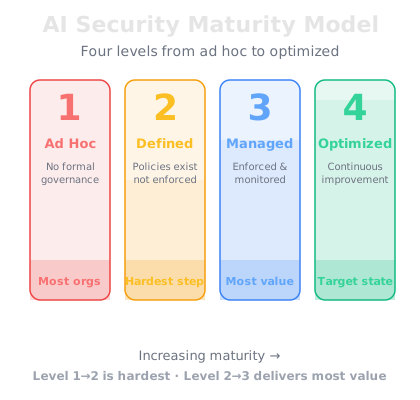
Maturity model for AI security
Use a maturity model to assess current state and plan improvements:
Level 1: Ad hoc — AI systems deployed without formal governance. Security involvement is reactive. No AI asset inventory. This is where most organizations are today.
Level 2: Defined — AI governance charter exists. Policies are documented. Asset inventory is started but incomplete. Risk assessments happen but inconsistently.
Level 3: Managed — Policies are enforced through automated controls. Complete asset inventory maintained. Risk assessments are systematic. Monitoring is operational. Metrics are reported.
Level 4: Optimized — Continuous improvement based on metrics. Predictive risk management. Automated compliance. AI security is embedded in the development lifecycle. Industry leadership.
Metrics and KPIs for AI security
What you measure determines what gets attention. AI security metrics fall into three categories:
Operational metrics — What's happening day to day?
- Number of AI models in production (registered vs. total)
- Percentage of models with completed risk assessments
- Mean time to detect AI anomalies
- AI incident count by severity
Risk metrics — What's our exposure?
- Percentage of high-risk AI systems with full controls implemented
- Number of models past retraining threshold
- Vendor risk assessment completion rate
- Compliance gap count by regulation
Board-level metrics — What does leadership need to know?
- AI risk posture trend (improving/stable/declining)
- Regulatory compliance status (compliant/gaps/violations)
- AI security program maturity level and trajectory
- Investment vs. risk reduction ROI
Report operational metrics monthly, risk metrics quarterly, and board metrics quarterly or as needed. Trend matters more than absolute numbers — show improvement trajectory.
Budget justification and ROI
AI security competes for budget with every other initiative. Build your business case around:
Risk reduction — Quantify the cost of AI incidents: regulatory fines, reputational damage, business disruption. EU AI Act fines can reach 7% of global annual turnover.
Regulatory compliance — Non-compliance is not optional. Frame AI security spending as compliance cost, not discretionary investment.
Enabling innovation — A well-governed AI program enables faster, safer deployment. Position security as an accelerator, not a blocker. Organizations with mature AI governance deploy models faster because approval processes are predictable.
Insurance and liability — Insurers increasingly ask about AI governance. Mature programs may reduce premiums or improve coverage.
Start with quick wins that demonstrate value: asset inventory, basic risk classification, and policy development cost relatively little and show immediate governance improvement.
Change management: getting engineering buy-in
The biggest challenge in AI security isn't technology — it's organizational change. Engineering teams that have been deploying models without governance review will resist new processes.
Lead with enablement, not restriction. Frame governance as enabling faster, safer deployment — not as a gatekeeping function.
Involve engineering in policy development. Policies developed without engineering input will be impractical and ignored. Co-creation builds ownership.
Start with high-risk systems. Don't try to govern everything at once. Start with the AI systems that pose the highest risk. Demonstrate value, then expand.
Automate governance touchpoints. Manual approval processes create bottlenecks. Automate where possible: automated risk scoring, policy compliance checks in CI/CD, self-service model registration.
Measure and report. Show engineering teams that governance doesn't slow them down — or if it does, show what you're doing to improve the process.
The exam will present scenarios where you must choose between comprehensive governance and pragmatic phased implementation. ISACA generally favors risk-based prioritization over boil-the-ocean approaches.