Exam Strategy, ISACA Mindset, and Practice Assessment
⏱ 25 min📊 AdvancedISACA AAISM Certification Prep
This is it — Day 18. Today we consolidate the ISACA mindset, review exam logistics, and complete a 15-question timed mini practice exam covering all three domains. Everything you've learned in 17 days comes together here.
The ISACA governance-first methodology
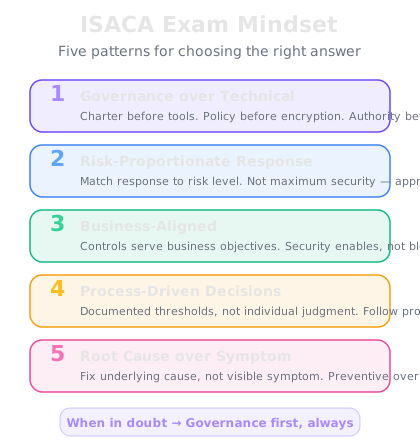
The single most important exam strategy: ISACA thinks governance first.
When you see a question where two answers seem correct — one governance-focused and one technical — choose governance. This pattern appears repeatedly across all three domains.
Risk-proportionate over maximum security: ISACA doesn't want you to lock everything down. They want you to match the response to the risk level. A low-risk AI chatbot doesn't need the same controls as a high-risk credit decisioning model.
Business-aligned over security-purist: Security serves business objectives. A control that prevents the business from operating defeats its purpose. The correct answer often balances security with business enablement.
Process-driven over ad hoc: Correct answers reference documented processes, predefined thresholds, and established procedures. Avoid answers that rely on individual judgment without process backing.
Root cause over symptom: When addressing a problem, choose the answer that fixes the underlying cause, not just the visible symptom.
Memorize these five patterns. They appear in nearly every AAISM exam question.
Exam time management
90 questions in 150 minutes = 100 seconds per question.
That's generous. You have time to think, but don't overthink.
Strategy:
- First pass: Answer every question. Don't skip any. Your first instinct is usually correct for governance-mindset questions.
- Flag uncertain questions for review. Aim to flag no more than 15-20 questions.
- Second pass: Review flagged questions with fresh eyes. Change an answer only if you have a clear reason.
- Time check: At 60 minutes, you should be past question 35. At 120 minutes, past question 70.
Distractor patterns to watch for:
- Technically correct but governance-wrong: The answer is technically accurate but doesn't align with ISACA's governance-first approach.
- Too aggressive: The answer involves shutting down systems, firing people, or maximum security responses when a proportionate response is available.
- Too passive: The answer involves accepting risk, deferring action, or delegating when the scenario calls for active management.
- Out of scope: The answer addresses a real concern but not the concern the question is asking about.
Domain-specific exam tips
Domain 1 (31% — Governance): Questions focus on program design, stakeholder management, and policy development. The correct answer usually involves establishing governance structures before taking action.
Domain 2 (31% — Risk): Questions focus on risk assessment, treatment, and ongoing management. The correct answer usually involves proportionate, process-driven responses based on predefined criteria.
Domain 3 (38% — Technologies & Controls): The largest domain, but tested at management level. Questions ask you to evaluate and approve controls, not implement them. The correct answer usually involves root cause controls and comprehensive rather than point solutions.
Cross-domain pattern: Many questions span domains. A question about a model failure might test governance (incident response procedure), risk (residual risk management), and controls (monitoring gaps) simultaneously. Read the question carefully to identify which domain perspective they're testing.
15-question practice exam
Complete these 15 questions (5 per domain) in 25 minutes. Apply the ISACA mindset. Explanations follow each question.
Practice Exam — Domain 1 (Q1)
An organization is establishing its first AI governance program. The board has approved the charter and budget. What should the AI security manager do NEXT?
**After charter, inventory.** You need to know what AI systems exist before you can develop policies for them, hire the right staff, or deploy monitoring. Inventory answers the question: "What are we governing?"
Practice Exam — Domain 1 (Q2)
The AI governance committee meets quarterly. Between meetings, an engineering team deploys an AI system that processes customer financial data without governance review. The system has been live for two weeks. What is the BEST immediate action?
**Balanced response.** Retrospective review addresses the immediate risk. Strengthening deployment controls addresses the root cause. Emergency committee meeting is overreaction for a working system. Taking it offline may be disproportionate. Waiting until next quarter is too slow.
Practice Exam — Domain 1 (Q3)
A CISO asks the AI security manager to benchmark the organization's AI governance maturity against peers. The organization has documented policies but inconsistent enforcement. What maturity level is this?
**Level 2: Defined.** The key differentiator between Level 2 and Level 3 is enforcement. Documented policies with inconsistent enforcement = Level 2. Consistent enforcement through automated controls = Level 3.
Practice Exam — Domain 1 (Q4)
An AI system used for employee scheduling has been operating for a year. HR reports that certain employee groups consistently receive less favorable schedules. No bias testing was done before deployment. What should the AI security manager prioritize?
**Governance process with interim controls.** Follow documented procedures (not ad hoc response), assess regulatory implications (employment law), and add human oversight as an interim control while investigation proceeds. Don't suspend without assessment, and don't retrain without understanding the root cause.
Practice Exam — Domain 1 (Q5)
The board asks for a single metric that best represents the organization's AI governance program effectiveness. What do you recommend?
**Maturity level with trajectory.** A single maturity score captures the overall program state, and the trajectory shows whether things are improving. Individual metrics (registration rate, incident count, risk assessment completion) are important operational metrics but don't give the board the holistic view they need.
Practice Exam — Domain 2 (Q6)
A risk assessment identifies that an AI customer service chatbot could be manipulated through prompt injection to disclose internal knowledge base content. The likelihood is assessed as medium, the impact as high (proprietary information exposure). What is the MOST appropriate risk treatment?
**Mitigate with layered controls.** Medium likelihood and high impact warrants active mitigation. Acceptance is inappropriate for high-impact risks. Avoidance is disproportionate. Transfer doesn't actually prevent the exposure — it only shifts financial liability.
Practice Exam — Domain 2 (Q7)
During vendor due diligence for an AI analytics platform, the vendor discloses that their model was trained on publicly available data that may include personal information. The vendor argues this is standard practice. What is the PRIMARY risk concern?
**Regulatory liability.** Using personal data from public sources without proper legal basis violates GDPR and similar regulations. The organization inherits this liability by using the vendor's model. This is a vendor risk that must be addressed contractually and assessed for compliance impact.
Practice Exam — Domain 2 (Q8)
An organization operates three AI systems classified as high-risk under the EU AI Act. Annual compliance cost for all three is estimated at $400K. The business benefit from the three systems is $2M annually. A new regulation proposes additional requirements estimated at $200K annually. What risk management approach is MOST appropriate?
**Individual cost-benefit analysis.** The aggregate numbers hide important details. One system might generate $1.5M in benefit while another generates $100K. Risk-informed decisions require per-system analysis, not aggregate budgeting.
Practice Exam — Domain 2 (Q9)
A quarterly risk review shows that AI risk #7 (model drift for the fraud detection system) has been rated "medium" for four consecutive quarters despite being assigned to the ML team for mitigation. What should the AI security manager do?
**Investigate, don't assume.** A stable risk rating could mean the treatment is working to prevent escalation, or it could mean the treatment isn't being executed. Investigation determines the actual situation before escalation or acceptance.
Practice Exam — Domain 2 (Q10)
The organization is expanding into a new market where AI regulations are minimal. Engineering proposes relaxing AI governance for systems deployed in this market to accelerate competitive advantage. What is the BEST response?
**Governance beyond compliance.** AI governance serves risk management, ethical, and reputational purposes — not just regulatory compliance. Operating with lower standards in one market creates reputational risk globally. Evaluate against organizational values and risk appetite, not just local regulations.
Practice Exam — Domain 3 (Q11)
An architecture review reveals that an AI model serving API has no authentication — it relies on network-level access controls (the API is only accessible from the internal network). What is the PRIMARY concern?
**Defense-in-depth principle.** Network controls alone violate defense-in-depth. Application-layer authentication provides protection even if network controls fail (lateral movement after breach, VPN compromise, insider threat). This is a fundamental architectural security principle.
Practice Exam — Domain 3 (Q12)
A production ML pipeline automatically retrains the fraud detection model weekly using the latest transaction data. The retrained model is automatically deployed if accuracy exceeds 95% on the validation set. What is the MOST significant control gap?
**Governance bypass.** Automated deployment based solely on accuracy bypasses governance review for security, fairness, and compliance. A model could pass the accuracy threshold while exhibiting bias, security vulnerabilities, or compliance gaps. Human governance review must be part of the deployment pipeline.
Practice Exam — Domain 3 (Q13)
A generative AI system is deployed with output filtering that blocks harmful content. Testing shows the filter catches 97% of harmful outputs. The remaining 3% are subtle cases the filter misses. What is the MOST appropriate additional control?
**Layered controls for residual risk.** No single control achieves 100%. Layer multiple controls: better filtering (reduce the gap), human review for high-risk outputs (catch what the filter misses), monitoring (detect patterns), and user reporting (crowdsource detection). This manages the residual risk rather than accepting it.
Practice Exam — Domain 3 (Q14)
The security team discovers that an AI model can be tricked into misclassifying inputs by adding imperceptible noise — a classic adversarial evasion attack. The data science team proposes adversarial training to harden the model. What should the security manager ensure?
**Continuous control, not one-time fix.** Adversarial techniques evolve. A model hardened against today's attacks may be vulnerable to tomorrow's. The security manager should ensure adversarial robustness becomes a **permanent part of validation** — continuous testing with evolving attack scenarios.
Practice Exam — Domain 3 (Q15)
An organization is preparing for a regulatory audit of their AI systems. The auditor will assess governance, risk management, and controls. What is the MOST important preparation activity?
**Documentation plus verification.** The worst audit outcome isn't having gaps — it's claiming controls exist when they don't. Ensure documentation matches reality. If gaps exist, document them along with remediation plans. Auditors respect honest self-assessment far more than paper compliance that falls apart under scrutiny.
Exam logistics
Delivery: PSI test centers or remote proctoring (PSI Bridge). Remote proctoring requires a private room, webcam, and stable internet.
Scheduling: You have 12 months from registration to schedule and sit the exam.
Retake policy: If you don't pass, you can retake after a waiting period. Check ISACA's current retake policy, as it may have evolved since launch.
What to bring: Government-issued photo ID. No notes, no devices, no reference materials in the testing room.
During the exam: You can mark questions for review. Use this for questions where you're genuinely uncertain — not for every question. A scratch pad (physical or digital depending on format) is typically provided.
Your personalized study reference
Build a one-page reference sheet covering the key frameworks, concepts, and patterns from this course. You can't bring it to the exam, but creating it reinforces the material.
Include:
- NIST AI RMF functions (Govern, Map, Measure, Manage)
- EU AI Act risk classification (Unacceptable, High, Limited, Minimal)
- AI governance maturity levels (Ad hoc, Defined, Managed, Optimized)
- Key regulatory triggers (GDPR Article 22, EU AI Act serious incident reporting, sector-specific requirements)
Review this reference daily in the days leading up to your exam. The patterns will become second nature.
Final thoughts
You've completed 18 days of focused AAISM preparation. You've covered all three exam domains, practiced 117 questions, and internalized the ISACA governance-first mindset.
Remember on exam day:
- Governance over technical
- Proportionate over maximum
- Process over ad hoc
- Root cause over symptom
- Assess before acting
You already have the security management foundation from CISM/CISSP. The AAISM extends that foundation into AI. Trust your experience, apply the ISACA mindset, and you'll be well-prepared.
Good luck.
🎓
Course Complete — All 18 Days Done
"When governance and technical answers both seem correct, ISACA wants governance. Proportionate response, process-driven decisions, root cause controls."