Data Governance and Intellectual Property for AI
This lesson covers one of the v2.1 BoK updates — a new emphasis on data governance and IP policy specifically for AI. The exam now explicitly tests your ability to evaluate and update data governance policies for AI requirements.
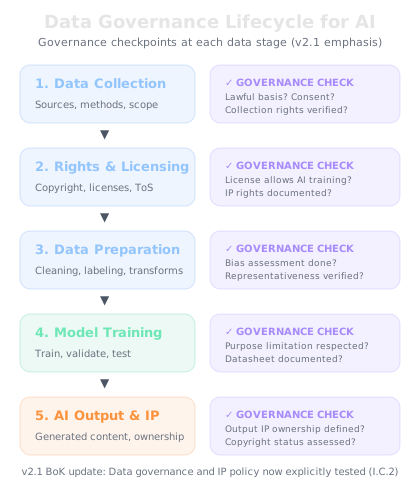
Data Governance for AI — Beyond Traditional Data Management
Traditional data governance focuses on accuracy, access control, retention, and compliance. AI introduces additional requirements:
Data provenance — Where did the training data come from? Can you trace its origin? This matters for legal compliance, bias detection, and regulatory audits.
Data lineage — How has the data been transformed from its source to the training dataset? Every transformation step (cleaning, augmentation, labeling) must be documented.
Representativeness — Does the training data adequately represent all groups the AI will affect? Unrepresentative data leads to biased models.
Purpose limitation — Was the data collected for a purpose compatible with AI training? Using customer data collected for service delivery to train an AI model may violate privacy regulations.
Data quality for AI — AI-specific quality dimensions include: label accuracy (for supervised learning), temporal relevance (is the data current?), and distributional alignment (does the training distribution match the deployment environment?).
Intellectual Property and AI
AI creates novel IP challenges that the AIGP exam tests from multiple angles:
Training data rights:
- Using copyrighted material to train AI models is legally contested (ongoing lawsuits by NYT, authors, artists)
- Open-source data may have license restrictions on commercial use
- Web-scraped data may violate terms of service
- Personal data used for training requires lawful basis under privacy law
AI-generated content ownership:
- Who owns content generated by AI? The user who prompted it? The organization? The AI company?
- US Copyright Office position: purely AI-generated works are not copyrightable
- Works with significant human authorship that use AI as a tool may be copyrightable
- Organizations need clear policies on IP ownership of AI-assisted work
Trade secret protection:
- Employees inputting trade secrets into third-party AI tools may destroy trade secret status
- AI model weights and training data may themselves be trade secrets
- Reverse engineering risks: model outputs may reveal proprietary training data
Updating Data Governance for AI Use Cases
The v2.1 BoK specifically requires you to evaluate and update existing data governance policies for AI. Here's a practical framework:
Step 1: Inventory — Identify all data sources used for AI training, validation, and operation.
Step 2: Rights assessment — For each data source, verify: Do we have the right to use this data for AI? Are there license restrictions? Consent requirements?
Step 3: Quality assessment — Evaluate data quality against AI-specific dimensions (representativeness, label accuracy, temporal relevance).
Step 4: Policy gaps — Compare existing data governance policies against AI requirements. Common gaps include: no purpose limitation policy for AI training, no data provenance requirements, no synthetic data governance.
Step 5: Policy updates — Update policies to address identified gaps. Include AI-specific provisions in data classification, retention, access control, and quality assurance policies.
Real-World Scenario
In December 2023, The New York Times filed a landmark lawsuit against OpenAI and Microsoft, alleging that millions of its copyrighted articles were used without permission to train GPT models. The Times demonstrated that ChatGPT could reproduce near-verbatim excerpts of its articles, undermining both the copyright and the commercial value of its journalism. This case joined a wave of similar litigation from authors (including Sarah Silverman and George R.R. Martin), visual artists, and Getty Images, all challenging the use of copyrighted works as AI training data.
The NYT v. OpenAI case crystallizes every major IP challenge in AI governance. On the training data side, it raises fundamental questions about whether scraping copyrighted content constitutes fair use or infringement — a question that remains unresolved in US courts. On the output side, the model's ability to reproduce training content nearly verbatim exposes a data governance failure: insufficient deduplication and memorization controls during training. The case also highlights the importance of data provenance — OpenAI could not easily demonstrate the full scope of copyrighted content in its training sets.
For the AIGP exam, this scenario tests multiple governance concepts simultaneously: data provenance tracking, IP rights assessment for training data, the distinction between fair use and infringement in AI contexts, and the organizational risk of deploying models trained on disputed data. Organizations building or procuring AI systems must conduct thorough rights assessments of training data sources and maintain documentation of data lineage — or face legal exposure like OpenAI's.
Go Deeper
Want to see these concepts applied to full case studies? Check out AIGP Scenarios — 10 real-world governance simulations mapped to the AIGP exam domains.