Ethical, Responsible, and Trustworthy AI
These three terms — ethical AI, responsible AI, and trustworthy AI — are used constantly in AI governance discussions. The AIGP exam will test whether you understand how they differ and how they relate to each other.
Many candidates treat them as interchangeable. They're not. Understanding the distinction is critical.
Ethical AI — The Foundation
Ethical AI refers to the philosophical and value-driven approach to designing and using AI systems. It asks: What should AI do? What values should guide its development?
Core ethical principles include:
- Fairness — AI should not discriminate or produce unjust outcomes
- Transparency — People should understand how AI systems affect them
- Accountability — Someone must be responsible for AI outcomes
- Beneficence — AI should benefit people and society
- Non-maleficence — AI should not cause harm
- Autonomy — AI should respect human agency and decision-making
Ethical AI is about aspirations and values. An organization with an AI ethics statement has ethical AI principles — but principles alone don't create governance.
Responsible AI — The Operationalization
Responsible AI takes ethical principles and turns them into processes, practices, and controls. It answers: How do we ensure AI actually behaves ethically in practice?
Responsible AI includes:
- Governance frameworks — Policies, standards, and procedures for AI development and use
- Risk management — Systematic identification, assessment, and mitigation of AI risks
- Impact assessments — Evaluating potential harms before deploying AI systems
- Testing and validation — Fairness audits, bias testing, robustness checks
- Documentation — Model cards, data sheets, decision logs
- Monitoring — Ongoing tracking of AI system performance and fairness in production
Think of it this way: ethical AI says "we believe in fairness." Responsible AI builds the fairness testing pipeline, assigns ownership, and creates escalation procedures.
Trustworthy AI — The Measurable Outcome
Trustworthy AI is the result of responsible AI practices. It's the measurable, verifiable state where an AI system can be trusted by its stakeholders.
The EU's High-Level Expert Group (HLEG) defined seven requirements for trustworthy AI:
1. Human agency and oversight — AI systems should support human autonomy and decision-making
2. Technical robustness and safety — AI should be resilient, secure, and reliable
3. Privacy and data governance — Full respect for privacy and appropriate data management
4. Transparency — Traceability, explainability, and open communication about limitations
5. Diversity, non-discrimination, and fairness — Avoid unfair bias and ensure accessibility
6. Societal and environmental well-being — Consider broader societal and environmental impact
7. Accountability — Mechanisms for responsibility and redress
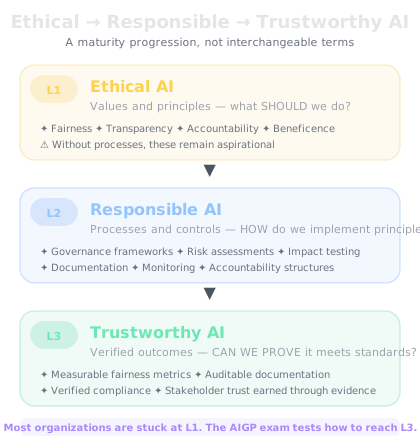
The Relationship — A Maturity Progression
Think of these three concepts as a maturity progression:
Ethical AI (Level 1) → We have principles and values
Responsible AI (Level 2) → We have processes to operationalize those principles
Trustworthy AI (Level 3) → We can demonstrate and verify that our AI meets those standards
Organizations often get stuck at Level 1. They publish an ethics statement, appoint an ethics board, and declare victory. The AIGP exam tests whether you can identify this gap and know how to bridge it.
The bridge from principles to practice requires:
- Translating abstract principles into specific, measurable requirements
- Assigning clear ownership for each requirement
- Building testing and monitoring to verify compliance
- Creating escalation paths for when requirements aren't met
- Establishing continuous improvement loops
The EU HLEG Framework in Detail
The AIGP exam frequently references the EU's HLEG trustworthy AI framework. Let's unpack the seven requirements:
1. Human agency and oversight — AI should not undermine human autonomy. Users should be able to understand and, where appropriate, override AI decisions. This maps to human-in-the-loop and human-on-the-loop oversight models.
2. Technical robustness and safety — AI must work reliably and handle errors gracefully. This includes resilience to adversarial attacks, fallback plans, and accuracy requirements.
3. Privacy and data governance — AI must comply with data protection regulations and respect privacy rights throughout the data lifecycle.
4. Transparency — Three layers: the AI system itself should be traceable, decisions should be explainable to affected parties, and organizations should communicate openly about AI capabilities and limitations.
5. Diversity, non-discrimination, and fairness — Avoid creating or reinforcing unfair bias. Ensure AI is accessible to diverse users and stakeholders.
6. Societal and environmental well-being — Consider the broader impact, including environmental sustainability of AI systems and their effects on social institutions.
7. Accountability — Establish audit mechanisms, enable reporting of issues, and ensure redress is available for those negatively affected by AI.
Real-World Scenario
Amazon's AI recruiting tool, developed starting in 2014, became one of the most cited examples of the gap between ethical AI aspirations and responsible AI practices. The system was trained on resumes submitted to Amazon over a ten-year period — a dataset that reflected the male-dominated tech industry. The AI learned to systematically downgrade resumes containing the word "women's" (as in "women's chess club captain") and penalized graduates of all-women's colleges. Amazon disbanded the team in 2018 after concluding the tool could not be fixed to be gender-neutral.
This case illustrates the maturity progression in action. Amazon likely had ethical AI principles — few major tech companies would endorse gender discrimination. But ethical principles alone did not prevent the harm. What was missing was responsible AI operationalization: bias testing against demographic groups before deployment, representative training data assessment, fairness metrics with defined thresholds, and a human oversight mechanism to catch discriminatory patterns. Had Amazon built the bridge from principles to practice — translating "we believe in fairness" into a fairness testing pipeline with clear ownership — the issue would have been caught before the tool was ever used on real candidates.
For the AIGP exam, Amazon's recruiting tool is the canonical example of an organization stuck at Level 1 (ethical AI aspirations) without progressing to Level 2 (responsible AI processes) or Level 3 (trustworthy AI outcomes that can be verified and demonstrated to stakeholders).
Go Deeper
Want to see these concepts applied to full case studies? Check out AIGP Scenarios — 10 real-world governance simulations mapped to the AIGP exam domains.