Human Oversight Models for AI Systems
Human oversight is one of the most frequently tested concepts on the AIGP exam. The EU AI Act mandates it for high-risk AI (Article 14), and the NIST AI RMF embeds it across all functions. Today you'll master the three oversight models and learn to avoid the trap of automation bias.
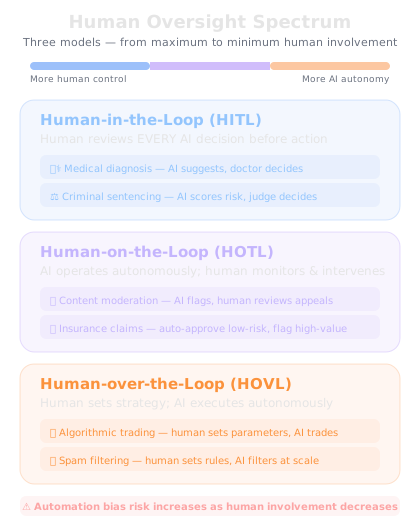
The Three Oversight Models
Human-in-the-Loop (HITL)
The human reviews and approves every AI decision before it's actioned.
- Use case: Medical diagnosis support — AI suggests a diagnosis, doctor makes the final call
- When appropriate: High-stakes decisions with significant individual impact; decisions requiring professional judgment
- Limitation: Doesn't scale well; high cost; humans may rubber-stamp over time (automation bias)
Human-on-the-Loop (HOTL)
The AI operates autonomously, but a human monitors and can intervene when needed.
- Use case: Content moderation — AI automatically removes flagged content, human moderators review edge cases and appeals
- When appropriate: Medium-risk decisions at scale; decisions where speed matters but oversight is needed
- Limitation: Requires well-designed intervention triggers; human may miss issues in high-volume monitoring
Human-over-the-Loop (HOVL)
The human provides strategic oversight — setting objectives, reviewing aggregate performance, and adjusting parameters — but doesn't review individual decisions.
- Use case: Algorithmic trading — human sets strategy and risk parameters, AI executes trades
- When appropriate: Low-risk individual decisions at very high volume; autonomous systems operating within defined boundaries
- Limitation: Individual harmful decisions may not be caught; requires robust monitoring and guardrails
Automation Bias and Complacency
The biggest threat to human oversight is automation bias — the tendency for humans to over-rely on AI recommendations and fail to exercise independent judgment.
How automation bias manifests:
- Rubber-stamping AI decisions without meaningful review
- Not questioning AI outputs even when they seem unusual
- Spending less time reviewing as trust in the AI increases
- Interpreting ambiguous information in ways that confirm the AI's recommendation
Governance countermeasures:
- Training — Ensure oversight personnel understand the AI's limitations and error patterns
- Rotation — Rotate oversight personnel to prevent complacency
- Adversarial samples — Periodically inject known-wrong AI decisions to test whether humans catch them
- Decision aids — Provide additional context and data to support independent human judgment
- Accountability — Hold oversight personnel accountable for the quality of their reviews
- Workload management — Prevent oversight fatigue by managing review volumes
EU AI Act Article 14 — Human Oversight Requirements
For high-risk AI systems, Article 14 requires the provider to design systems that enable:
1. Understanding — Oversight personnel can properly understand the system's capabilities and limitations
2. Monitoring — The system's operation can be effectively monitored, including through appropriate human-machine interface tools
3. Interpretation — Output can be correctly interpreted by oversight personnel
4. Override — Oversight personnel can decide not to use the system, override, or reverse its output
5. Intervention — The system can be stopped ("stop button")
Key exam point: Article 14 places obligations on the provider to design for oversight and on the deployer to implement effective oversight with competent personnel.
Choosing the Right Oversight Model
Factors that determine the appropriate oversight model:
Risk level — Higher risk = more direct human involvement (HITL → HOTL → HOVL)
Volume — High-volume decisions may preclude HITL; consider HOTL with sampling
Speed — Time-critical decisions (fraud detection, autonomous vehicles) may require HOTL or HOVL
Reversibility — Irreversible decisions (medical treatment, termination) warrant HITL
Regulatory requirements — Some regulations mandate specific oversight levels
Domain expertise — Decisions requiring professional judgment need HITL with qualified reviewers
Real-World Scenario
The Boeing 737 MAX MCAS (Maneuvering Characteristics Augmentation System) failures in 2018 and 2019, which caused two crashes killing 346 people, serve as one of the most important cautionary tales for AI human oversight design. MCAS was an automated system that repeatedly pushed the aircraft's nose down based on data from a single angle-of-attack sensor. When that sensor malfunctioned, the system overrode pilot inputs with catastrophic results. Pilots were not adequately informed about MCAS's existence, were not trained on how to override it, and the system's design made it extremely difficult to counteract — violating every principle of effective human oversight.
Mapping this to the EU AI Act's Article 14 requirements, MCAS failed on all five dimensions: pilots could not properly understand the system's capabilities and limitations (they were not told about it), could not effectively monitor its operation (no dedicated indicator), could not correctly interpret its outputs (the nose-down behavior was indistinguishable from other malfunctions), struggled to override it (the system reactivated every 5 seconds), and could not reliably stop it (the disable procedure was buried in non-standard checklists). Boeing's design treated human oversight as a theoretical backup rather than a functional requirement.
For the AIGP exam, the MCAS case demonstrates why human oversight is not just a checkbox — it requires deliberate system design. It illustrates the deadly consequences of automation bias (pilots initially trusting the system over their own instruments), the importance of training oversight personnel on system limitations, and why Article 14's requirement that providers design systems to enable effective human oversight is fundamentally a safety-of-life issue, not merely a compliance exercise.
Go Deeper
Want to see these concepts applied to full case studies? Check out AIGP Scenarios — 10 real-world governance simulations mapped to the AIGP exam domains.