Security Throughout the AI Lifecycle
Every AI system moves through a lifecycle — from initial concept to production deployment and eventual retirement. Security must be embedded at every stage, not bolted on at the end. This lesson covers CY0-001 Objective 1.3 and teaches you to map specific security controls to each lifecycle phase.
The exam tests this heavily because it reflects how security teams must actually operate: understanding where to intervene, when each control has the highest return on investment, and how human oversight integrates into automated AI pipelines.
The AI Lifecycle Stages
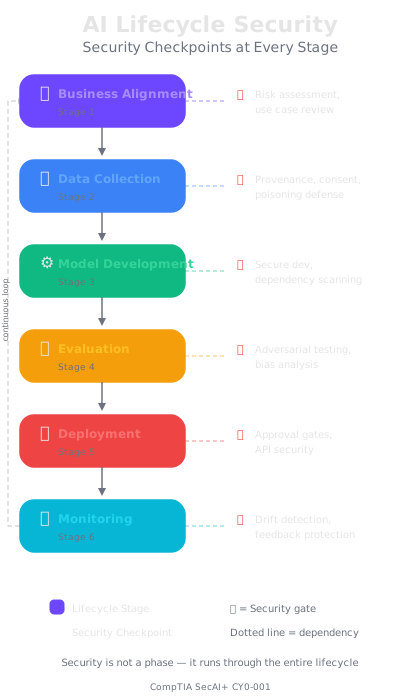
The CompTIA SecAI+ exam defines six core stages in the AI lifecycle. Each stage has distinct security requirements and risk profiles.
Stage 1: Business Use Case Alignment. Every AI project starts with a business justification. From a security perspective, this is where you assess whether the proposed AI application introduces acceptable risk. Key questions include: What data will the model access? What decisions will it influence? What is the blast radius if the model fails or is compromised? Security involvement at this stage has the highest ROI because it is far cheaper to reject a risky use case than to secure a flawed architecture after deployment.
Stage 2: Data Collection and Preparation. This is where training data is gathered, cleaned, labeled, and formatted. The security risks here are significant — data poisoning attacks target this stage specifically. Controls include verifying data provenance, establishing chain-of-custody documentation, validating data sources, and scanning for adversarial samples. Consent management is also critical: you must ensure that data was collected with appropriate permissions and complies with relevant regulations.
Stage 3: Model Development. Data scientists and ML engineers build and train the model. Security concerns include protecting the training environment from unauthorized access, securing hyperparameters and model architecture details (which can reveal attack surfaces), and ensuring reproducibility so that any training anomaly can be investigated. Secure development practices — version control, code review, dependency scanning — apply to ML code just as they do to traditional software.
Stage 4: Model Evaluation. The trained model is tested for accuracy, fairness, robustness, and security. This stage should include adversarial testing — deliberately attempting to break the model with edge cases, poisoned inputs, and prompt injection attacks. Evaluation criteria must be defined before training begins to prevent post-hoc rationalization. Bias testing checks whether the model treats different demographic groups equitably.
Stage 5: Deployment and Validation. The model moves to production. Security controls here include approval gates (who authorizes deployment?), canary deployments (gradual rollout to detect problems early), rollback procedures (how quickly can you revert to a previous version?), and integration testing (does the model interact safely with other systems?). API security — authentication, rate limiting, input validation — must be configured before the model accepts production traffic.
Stage 6: Monitoring, Maintenance, and Feedback. Once deployed, the model must be continuously monitored for performance degradation, adversarial attacks, data drift, and compliance violations. Feedback loops allow users and automated systems to report problems. Maintenance includes retraining with new data, patching dependencies, and updating guardrails as new attack techniques emerge. This stage never ends — it continues for the model's entire operational life.
Human-Centric AI Design Principles
The exam distinguishes between three closely related but distinct concepts. Getting these right on test day requires understanding the precise differences.
Human-in-the-loop (HITL) means a human is directly involved in the AI's decision-making process. The system cannot proceed without human input at defined decision points. Example: an AI flags suspicious transactions, but a human analyst must approve or reject each flag before any action is taken. HITL provides the strongest oversight but creates bottlenecks and does not scale to high-volume decisions.
Human-on-the-loop (HOTL) means a human monitors the AI's operations and can intervene when necessary, but the system can operate autonomously by default. The human observes a dashboard of AI decisions and steps in when something looks wrong. Example: an AI-powered firewall automatically blocks suspicious traffic, while a security analyst monitors the decisions and can override false positives. HOTL balances automation efficiency with human oversight.
Human oversight is the broadest term — it encompasses both HITL and HOTL, plus additional governance mechanisms like regular audits, performance reviews, and policy compliance checks. Human oversight does not require real-time involvement; it can be periodic and retrospective.
Human validation refers specifically to humans verifying the correctness of AI outputs. Unlike oversight (which monitors the process), validation focuses on the results. Example: a human reviewer checks AI-generated security reports for accuracy before distribution.
Security Intervention Points and ROI
Not all lifecycle stages offer equal security return on investment. The exam tests your understanding of where security resources should be concentrated.
Highest ROI: Business use case alignment and data collection. Catching a flawed concept or contaminated dataset early is exponentially cheaper than remediating problems in production. A poisoned model requires complete retraining. A misguided use case requires architectural redesign. Security review at these stages costs hours; remediation later costs weeks or months.
Medium ROI: Development and evaluation. Security testing during model development catches vulnerabilities before they reach production. Adversarial testing, bias analysis, and penetration testing of model APIs are all high-value activities at this stage. The cost of fixing issues is moderate — you are still in the development environment.
Lower ROI (but still essential): Deployment and monitoring. Security controls at deployment and monitoring are necessary but reactive. You are managing risk that should have been addressed earlier. Monitoring catches problems that slipped through earlier stages and detects new threats that emerge after deployment. The cost of remediation at this stage is highest because the model is already in production.
This does not mean you skip later-stage security. Defense in depth requires controls at every stage. But if you have limited security resources, the exam expects you to prioritize early-stage intervention.
Approval Gates and Rollback Procedures
Approval gates are formal checkpoints where designated stakeholders must authorize the AI system to proceed to the next lifecycle stage. A typical AI deployment might have three gates:
Gate 1 (Post-evaluation): The model has passed accuracy, fairness, and security testing. Data scientists sign off on model quality. Security signs off on adversarial testing results.
Gate 2 (Pre-deployment): Infrastructure is ready. API security is configured. Monitoring dashboards are active. Operations and security jointly approve production readiness.
Gate 3 (Post-deployment validation): The model has been running in production for a defined period. Real-world performance matches evaluation metrics. No unexpected behavior detected. Stakeholders approve full-scale deployment.
Rollback procedures define how to revert to a previous model version if problems are detected. Effective rollback requires versioning of models, training data, and configurations. You must be able to restore not just the previous model weights but the entire inference environment — including guardrails, prompt templates, and API configurations.
The exam expects you to know that rollback is not just a technical capability but an organizational process. Who can trigger a rollback? Under what conditions is it automatic versus manual? How quickly must rollback complete? These are governance questions as much as technical ones.
Continuous Security Posture
AI security is not a one-time assessment. The exam tests your understanding of continuous security as a lifecycle requirement.
Data drift occurs when the real-world data the model encounters in production differs from its training data distribution. A model trained on 2024 cyber threat data may perform poorly against 2026 threats. Data drift is a security concern because it degrades model accuracy and can create blind spots that attackers exploit.
Concept drift is when the relationship between inputs and outputs changes over time. What counted as a phishing email in 2024 looks different from phishing in 2026. The model's learned patterns become stale.
Model degradation is the result of drift — the model's real-world performance gradually decreases. Monitoring for degradation requires defining performance thresholds and alerting when the model drops below them.
Feedback loops allow humans and automated systems to report model errors, flag false positives and negatives, and suggest corrections. These loops feed back into the training pipeline, enabling continuous improvement. But feedback loops themselves can be attacked — if an adversary can submit enough false corrections, they can gradually shift model behavior. Securing the feedback pipeline is as important as securing the training pipeline.