AI Risks — Responsible AI and Shadow AI
Deploying AI without a responsible AI framework is like building a skyscraper without a safety code — it might stand for a while, but the consequences of failure are catastrophic. Yesterday we examined the governance structures and roles that keep AI accountable. Today we focus on the principles that should guide every AI decision and the risks that emerge when those principles are ignored. We also tackle one of the fastest-growing threats in enterprise security: Shadow AI — employees using unsanctioned AI tools outside IT's visibility. This lesson maps to CY0-001 Objective 4.2.
The Responsible AI Framework
Responsible AI is an umbrella term for the principles, practices, and governance mechanisms that ensure AI systems are developed and deployed in ways that are ethical, trustworthy, and aligned with human values. The SecAI+ exam tests your understanding of several core pillars of responsible AI. These are not abstract ideals — they translate directly into technical controls, policy requirements, and audit criteria.
Fairness requires that AI systems treat all individuals and groups equitably. In practice, this means testing models for demographic bias, ensuring training data represents diverse populations, and implementing ongoing monitoring for discriminatory outcomes. A hiring model that systematically scores candidates of a particular demographic lower — even without explicitly using demographic features — fails the fairness principle. Fairness is not just an ethical concern; it is increasingly a legal requirement under regulations like the EU AI Act.
Reliability and Safety demand that AI systems perform consistently and predictably under expected conditions, degrade gracefully under unexpected conditions, and never cause harm through malfunction. A self-driving vehicle that performs well in clear weather but fails catastrophically in rain is unreliable. A medical diagnostic model that provides confident but incorrect diagnoses is unsafe. Reliability requires rigorous testing across diverse scenarios, and safety requires fail-safe mechanisms that default to human control when the model's confidence drops.
Transparency means that stakeholders can understand how an AI system works, what data it uses, and how it reaches its conclusions. Transparency operates at multiple levels: organizational transparency about the fact that AI is being used, technical transparency about the model's architecture and training data, and decision transparency about how individual outputs are generated. Transparency does not always require full explainability of every model weight — but it does require sufficient disclosure for stakeholders to make informed decisions about trusting the system.
Privacy and Security require that AI systems protect the confidentiality, integrity, and availability of data throughout the AI lifecycle. This includes securing training data against unauthorized access, preventing models from memorizing and leaking sensitive information, protecting inference endpoints against adversarial manipulation, and ensuring that AI-generated outputs do not inadvertently disclose private information. Privacy and security are deeply intertwined in AI systems — a model that memorizes training data is both a privacy violation and a security vulnerability.
Responsible AI Principles Continued
Explainability goes beyond transparency to provide meaningful reasons for specific AI decisions. While transparency asks "can we see how this works?", explainability asks "can we understand why this particular output was produced?" Explainability is especially critical in regulated industries like healthcare, finance, and criminal justice, where decisions must be justifiable. Techniques like SHAP (SHapley Additive exPlanations), LIME (Local Interpretable Model-agnostic Explanations), and attention visualization help make complex models more interpretable. For the exam, know that explainability is a spectrum — a linear regression is inherently explainable, while a deep neural network may require post-hoc explanation techniques.
Inclusiveness ensures that AI systems are designed to benefit and be accessible to the widest possible range of users, including people with disabilities, non-native language speakers, and underrepresented communities. Inclusiveness extends beyond avoiding harm — it proactively seeks to ensure that AI benefits are broadly distributed. An AI-powered customer service system that only works well with standard American English accents fails the inclusiveness principle.
Accountability establishes clear ownership and responsibility for AI system outcomes. Every AI system should have identifiable individuals or teams who are responsible for its behavior, who can be held accountable when things go wrong, and who have the authority to modify or shut down the system. Accountability requires documentation — model cards, decision logs, approval records — that create an auditable trail from design decisions to production outcomes. Without accountability, organizations cannot learn from AI failures or hold the right people responsible.
Consistency requires that AI systems produce stable, reproducible results across similar inputs and over time. Inconsistent outputs erode user trust and make it impossible to audit or validate AI decisions. Consistency is challenged by model drift — the gradual degradation of model performance as the real-world data distribution shifts away from the training data distribution. Organizations must implement drift detection and automated retraining pipelines to maintain consistency over time.
Building an AI-Literate Security Culture
Responsible AI principles only matter if the people in the organization understand them. Awareness training is a critical component of AI governance that transforms abstract principles into daily practice.
Effective AI awareness training should target multiple audiences. Executives need to understand the strategic risks and regulatory obligations associated with AI. Technical teams need to understand secure development practices, bias testing methodologies, and incident response procedures for AI systems. Business users — the people who interact with AI tools daily — need to understand acceptable use policies, data handling restrictions, and how to report suspicious AI behavior.
Training should cover the organization's specific AI policies, including which tools are sanctioned, what data can be used with AI systems, and how to request new AI capabilities through proper channels. It should also cover the broader threat landscape: how adversarial attacks work, why feeding sensitive data into public AI tools is dangerous, and what social engineering attacks leveraging AI look like.
The goal is an AI-literate security culture where every employee understands their role in responsible AI use. This is not a one-time training event — it requires regular updates as the AI landscape evolves, new tools are introduced, and new threats emerge. Tabletop exercises that simulate AI-related incidents — a model producing biased outputs, a data breach via an AI tool, a deepfake used in social engineering — help teams practice their response in a low-stakes environment.
Risk Categories — Bias, Data Leakage, and Reputation
AI systems introduce several categories of risk that go beyond traditional cybersecurity concerns. The exam expects you to identify and differentiate these categories.
Bias introduction occurs when AI systems produce systematically unfair outcomes. Bias can enter through training data that underrepresents certain populations, through feature selection that uses proxies for protected characteristics, through labeling processes that embed human prejudices, or through optimization objectives that inadvertently favor one group over another. Bias is not always intentional — in fact, most bias in production AI systems is accidental, which makes it harder to detect. Organizations must implement bias testing at multiple points in the ML lifecycle: during data preparation, after model training, and continuously in production.
Accidental data leakage is one of the most common and underestimated AI risks. It occurs when employees input sensitive data into AI systems that are not authorized to process it. A developer who pastes proprietary source code into a public code completion tool, a lawyer who uploads confidential client documents to a cloud-based summarization service, or a healthcare worker who enters patient information into a general-purpose chatbot — all of these are accidental data leakage events. The data may be stored by the AI provider, used for model training, or accessible to other users. Preventing accidental data leakage requires a combination of policy (acceptable use restrictions), technical controls (DLP systems that monitor AI tool usage), and training (educating users about the risks).
Reputational loss can result from any AI failure, but it is especially severe when AI systems produce biased, offensive, or demonstrably false outputs that become public. A customer-facing chatbot that generates racist responses, a recommendation system that surfaces inappropriate content, or a hiring tool that demonstrably discriminates will generate media attention and erode public trust. Reputational risk is difficult to quantify but can be more damaging than direct financial losses. Organizations must implement content filtering, output monitoring, and rapid response procedures to mitigate reputational risk.
Model Accuracy, IP Risks, and Autonomous Systems
Model accuracy and performance risks arise when AI systems produce incorrect or unreliable outputs. In security contexts, a false positive flood from an AI-powered SIEM can cause alert fatigue and lead analysts to miss genuine threats. A false negative from an AI-driven malware detector can allow a breach. Model performance typically degrades over time as the data distribution shifts — a phenomenon called model drift or data drift. Organizations must establish performance baselines, implement continuous monitoring, and define thresholds that trigger retraining or human review.
Intellectual property (IP) risks associated with AI are multifaceted. Models trained on copyrighted material may reproduce that material in their outputs, creating legal liability. Models themselves represent significant intellectual property — a competitor who extracts a proprietary model through API queries (model extraction attacks) gains valuable trade secrets. Additionally, AI-generated content raises questions about ownership: who owns the output of a model that was trained on third-party data and prompted by an employee? Organizations need clear IP policies that address training data rights, model ownership, output ownership, and protection against model theft.
Autonomous systems risks emerge when AI systems take actions at scale without human oversight. An automated trading system that executes thousands of transactions per second can cause market disruptions if its model encounters unexpected conditions. An automated security response system that blocks network traffic based on AI analysis can cause widespread outages if it misclassifies legitimate traffic. The danger of autonomous systems is speed and scale — mistakes happen faster and affect more people than human errors. Responsible AI principles require that autonomous systems have clearly defined operational boundaries, human override mechanisms, and circuit breakers that halt automated actions when anomalies are detected.
Shadow AI — The Unsanctioned Threat
Shadow AI is the use of AI tools and services by employees without IT or security team knowledge, approval, or oversight. It is the AI-specific manifestation of the broader Shadow IT problem, and it is growing rapidly as AI tools become more accessible and more capable.
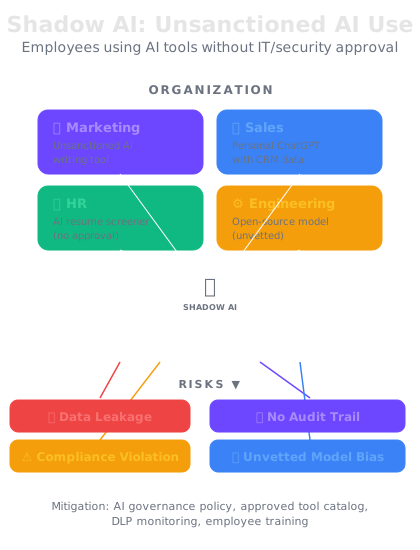
Shadow AI takes many forms. Marketing teams using AI writing tools to generate content without vetting the tool's data handling practices. Developers using AI code assistants that transmit proprietary code to external servers. HR teams using AI screening tools that may introduce bias into hiring. Finance teams using AI analytics platforms that process sensitive financial data outside the organization's security perimeter. In every case, the common thread is that the organization has no visibility into the AI tool being used, the data being sent to it, or the outputs being relied upon.
The risks of Shadow AI are significant. Data exposure — sensitive corporate, customer, or regulated data is sent to AI services whose data handling practices are unknown and unvetted. Compliance violations — data processing may violate GDPR, HIPAA, or industry-specific regulations. Accuracy risks — business decisions are being made based on AI outputs that have not been validated. Security risks — employees may be interacting with AI tools that are vulnerable to prompt injection, data exfiltration, or man-in-the-middle attacks. Governance gaps — AI is being used in ways that bypass the organization's governance framework, making audit and accountability impossible.
Detecting and Responding to Shadow AI
Detecting Shadow AI requires a multi-layered approach. Network monitoring can identify traffic to known AI service domains and APIs. Cloud Access Security Brokers (CASBs) can detect and control the use of cloud-based AI services. Endpoint Detection and Response (EDR) tools can identify AI applications installed on employee devices. Browser extensions and proxy configurations can log access to web-based AI tools. Procurement and expense monitoring can identify unauthorized AI tool purchases.
However, detection alone is insufficient. Organizations must also build a response strategy that balances security with productivity. A purely prohibitive approach — blocking all AI tools — is likely to fail because employees will find workarounds, and the organization will lose the productivity benefits of AI. A more effective approach combines four elements.
First, provide sanctioned alternatives — if employees are using Shadow AI tools because they need AI capabilities, give them approved tools that meet security and governance requirements. Second, enforce acceptable use policies — clearly communicate what is allowed and what is not, with specific examples relevant to each department. Third, implement technical controls — use DLP, CASB, and network monitoring to detect and prevent unauthorized AI tool usage and data exfiltration. Fourth, educate rather than punish — most Shadow AI use is not malicious; employees are trying to be more productive. Training that explains why unsanctioned AI tools are risky is more effective than punitive measures.
For the exam, remember that Shadow AI is primarily a governance and risk management problem, not just a technical security problem. The solution requires policy, technology, and culture working together.