Compensating Controls — Building the Defense Matrix
Welcome to Day 12 of your CompTIA SecAI+ preparation and the capstone lesson for Domain 2: Securing AI Systems. Over the past three lessons, you studied the full spectrum of AI attacks — from prompt injection and jailbreaking to model theft, supply chain compromise, and excessive agency. Today, you bring it all together by mapping each attack to its most effective compensating controls and building a layered defense strategy that protects AI systems at every level. A compensating control is an alternative security measure that provides equivalent protection when the primary control is impractical or insufficient. In the AI context, compensating controls are essential because no single defense can address the diverse and evolving threat landscape. This lesson maps to CY0-001 Objective 2.6 and will prepare you to design defense strategies on the exam and in production environments.
Prompt Firewalls as Compensating Controls
A prompt firewall is a security layer that sits between users and the AI model, inspecting incoming prompts and outgoing responses for malicious content. Think of it as a web application firewall (WAF) adapted for the AI context — it analyzes the semantic content of interactions rather than HTTP parameters.
Prompt firewalls operate in two directions. Inbound filtering analyzes user prompts before they reach the model. The firewall scans for known prompt injection patterns, jailbreaking techniques, encoding tricks, and policy-violating content. Advanced prompt firewalls use their own ML classifiers to detect novel attack patterns that rule-based filters would miss. Outbound filtering analyzes model responses before they reach the user. The firewall screens for leaked system prompts, sensitive data exposure, harmful content generation, and outputs that violate organizational policies.
What prompt firewalls catch well includes known injection patterns and their common variants, obvious jailbreaking attempts using well-documented techniques, responses that contain clearly identifiable sensitive data (PII, credentials), and outputs that match predefined prohibited content categories.
What prompt firewalls miss includes novel injection techniques that have not been seen before, indirect prompt injection embedded in external content that the model retrieves, subtle jailbreaking that uses creative framing rather than recognizable patterns, and hallucinated content that is factually incorrect but does not match any prohibited category.
As a compensating control, prompt firewalls are most effective against direct prompt injection and jailbreaking. They provide partial protection against indirect prompt injection (if the firewall can inspect retrieved content) and hallucination exploitation (if output filters check for factual claims). They provide minimal protection against model theft, model inversion, data poisoning, and supply chain attacks, which operate at different layers of the AI stack.
The key takeaway is that prompt firewalls are a necessary but insufficient control. They should be one layer in a defense-in-depth strategy, not the sole line of defense.
Model Guardrails — Configuration for Different Attack Profiles
Model guardrails are the safety behaviors, content policies, and behavioral constraints built into the model itself through training, fine-tuning, and configuration. Unlike prompt firewalls, which operate externally, guardrails are intrinsic to the model's behavior.
Guardrails can be configured at multiple levels. System-level guardrails are established during RLHF and safety training — they represent the model's baseline safety behavior. These are the hardest for attackers to bypass because they are deeply embedded in the model's weights. Deployment-level guardrails are configured through system prompts, content policies, and API parameters when the model is deployed for a specific use case. These are more easily customized but also more easily circumvented through prompt injection. Application-level guardrails are implemented in the application code surrounding the model — input preprocessing, output post-processing, and business logic constraints.
Different attack profiles require different guardrail configurations. For environments with high prompt injection risk (customer-facing applications, AI assistants that process external content), guardrails should emphasize instruction hierarchy — ensuring that system-level instructions cannot be overridden by user-level input. For environments with high data exfiltration risk (AI systems with access to sensitive internal data), guardrails should implement strict output filtering that prevents the model from revealing internal information regardless of how the request is framed. For environments with high harmful content risk (creative tools, open-ended generative applications), guardrails should focus on content classification and refusal behaviors.
Guardrail testing is essential. Organizations should conduct regular red-team exercises where security teams attempt to bypass deployed guardrails using the latest attack techniques. Guardrail configurations should be version-controlled, reviewed through change management processes, and updated as new attack techniques emerge. A guardrail configuration that was effective six months ago may be trivially bypassed today.
Access Controls and Least Privilege as Defense-in-Depth
Access controls and the principle of least privilege are foundational security concepts that take on new dimensions in the AI context. Every AI system has multiple access surfaces, and each must be independently controlled.
Model inference access controls who can query the model and at what rate. Authentication (API keys, OAuth tokens, mutual TLS) establishes identity. Authorization (role-based access control, attribute-based access control) determines what each authenticated principal can do. Rate limiting constrains how much each principal can do. Together, these controls mitigate model theft (by limiting query volume), denial-of-service (by preventing resource exhaustion), and unauthorized data access (by restricting who can interact with the model).
Training pipeline access controls who can modify training data, training code, hyperparameters, and model checkpoints. Least privilege dictates that data engineers should have access to data pipelines but not model deployment, ML engineers should have access to training infrastructure but not production inference endpoints, and operations teams should have access to deployment configurations but not training data. This separation mitigates data poisoning and model poisoning by limiting the number of principals who can influence the training process.
Tool and plugin access controls what actions the AI system can perform in the broader environment. An AI assistant should have access only to the specific tools and data sources required for its function — not blanket access to email, databases, code execution, and file systems. This directly mitigates the risk of excessive agency by ensuring that even a successfully compromised model cannot take actions outside its authorized scope.
Model artifact access controls who can download, copy, or inspect model weights, configuration files, and associated metadata. Restricting access to model artifacts mitigates model theft through direct exfiltration (as opposed to extraction through API queries) and prevents unauthorized modification of deployed models.
For the exam, remember that access controls for AI systems must cover all four surfaces: inference, training, tools, and artifacts. A gap in any one surface creates an attack path that compensating controls at other surfaces cannot fully address.
Data Integrity Controls — Checksums, Provenance, and Anomaly Detection
Data integrity controls protect the training data, fine-tuning data, RAG knowledge bases, and evaluation datasets that AI systems depend on. Because AI models are fundamentally shaped by their data, compromising data integrity compromises model integrity.
Cryptographic checksums (SHA-256, SHA-3) create fixed-size fingerprints of data files. By computing and storing checksums when data is first ingested and verifying them before each use, organizations can detect unauthorized modifications. Checksums should be applied to individual data files, complete datasets, and model weight files. Checksum verification should be automated and integrated into training and deployment pipelines so that corrupted or tampered data is detected before it can influence model behavior.
Data provenance tracking documents the complete lineage of every data asset — where it came from, who collected it, how it was processed, and what transformations were applied. Provenance metadata enables security teams to trace problems back to their source. If a model exhibits unexpected behavior, provenance records can identify which data sources contributed to the problematic behavior and whether any sources were compromised. Provenance is particularly important for supply chain defense — knowing exactly where your training data originated makes it possible to assess the trustworthiness of each source.
Anomaly detection on data pipelines uses statistical and ML techniques to identify unusual changes in incoming data. This includes monitoring data distribution drift (changes in the statistical properties of incoming data that might indicate poisoning), volume anomalies (unexpected increases or decreases in data volume), schema violations (data that does not conform to expected formats), and content anomalies (individual data points that are statistical outliers). Anomaly detection serves as an early warning system for data poisoning attacks and supply chain compromises that introduce tainted data into the pipeline.
Together, checksums, provenance, and anomaly detection form a data integrity triad that protects against training-time attacks. Checksums detect tampering. Provenance enables attribution and trust assessment. Anomaly detection catches novel attack patterns that checksums alone would miss (because a poisoned dataset that was never previously checksummed would pass verification despite being malicious).
Encryption as a Compensating Control
Encryption is a familiar security control, but its effectiveness varies significantly across different AI attack scenarios. Understanding where encryption helps — and where it does not — is critical for the exam.
Encryption helps protect against model theft via direct exfiltration. Encrypting model weights at rest means that an attacker who gains access to the storage system cannot use the model without the decryption key. Encryption in transit (TLS) protects model weights and inference data from interception during network transfer. Confidential computing (enclaves, trusted execution environments) can protect model weights even during inference, preventing the host operator from accessing the model.
Encryption helps protect against training data exfiltration. Encrypted training data stores prevent unauthorized access to the raw data. Encryption of data in transit protects against network-level interception during data movement between storage and training infrastructure.
Encryption does not help against prompt injection, jailbreaking, or hallucination exploitation — these attacks operate through the model's legitimate input-output interface, which encryption does not constrain. Encryption does not help against model theft via extraction (API-based querying) because the attacker interacts through the legitimate encrypted channel. Encryption does not help against data poisoning if the attacker has authorized access to the data pipeline — they can poison data before encryption or after decryption.
Encryption partially helps against model inversion and membership inference by protecting model artifacts from white-box analysis. If the attacker cannot access the model's weights (because they are encrypted), they are limited to black-box attacks through the API, which are generally less effective.
The lesson is clear: encryption is a valuable compensating control for confidentiality-related threats but provides no protection against integrity-related or logic-level attacks. It must be combined with other controls to provide comprehensive defense.
Prompt Templates and Rate Limiting — Reducing the Attack Surface
Prompt templates constrain how user input interacts with the model by embedding user-provided data within a predefined structure rather than allowing free-form input to be concatenated with system instructions.
In a free-form system, the model receives something like: "System: You are a helpful assistant. User: [whatever the user types]". The user's input is limited only by the context window, giving attackers maximum flexibility for injection. In a templated system, the model receives: "Analyze the following customer feedback and extract the sentiment. Feedback: [user_input]. Output only: Positive, Negative, or Neutral." The user's input is confined to a specific field with a specific purpose, and the model's expected output is tightly defined.
Prompt templates mitigate direct prompt injection by structuring the interaction so that user input is clearly delineated from system instructions. They mitigate jailbreaking by constraining the model's response format to predefined structures. They mitigate data exfiltration by limiting what the model can include in its response. However, templates are not foolproof — sophisticated injections can escape template boundaries, and templates that are too rigid may impair legitimate functionality.
Rate limiting controls the volume and velocity of requests to an AI system. Rate limits can be applied per user, per API key, per IP address, or globally. They mitigate model theft by making the large number of queries required for extraction impractically slow, model denial of service by preventing any single source from consuming excessive resources, denial-of-wallet attacks by capping the financial exposure from any single source, and model inversion by slowing down the iterative query process that inversion attacks require.
Rate limits should be configured with different tiers based on risk. Authenticated enterprise users might have higher limits than anonymous API consumers. Queries that request detailed probability distributions might have lower limits than queries that return only class labels (because detailed outputs are more useful for extraction and inversion attacks).
Building the Attack-to-Control Mapping Matrix
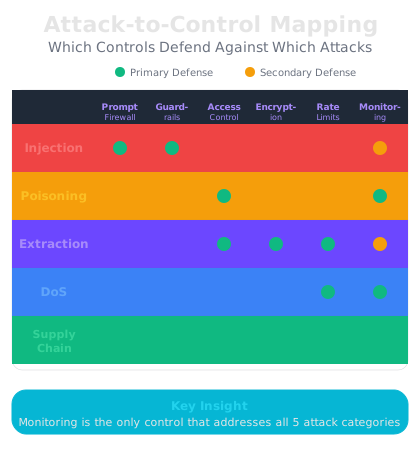
The culmination of Domain 2 is the ability to map each attack type to its most effective compensating controls. This attack-to-control mapping matrix is a practical tool for security architects and a framework the exam expects you to understand.
Prompt injection is best mitigated by prompt firewalls (inbound filtering), prompt templates (constraining input structure), privilege separation (limiting model actions), and output validation (verifying responses before execution). For indirect injection specifically, add content scanning of external data sources and input isolation that separates retrieved content from system instructions.
Data poisoning is best mitigated by data provenance tracking, data integrity checksums, anomaly detection on data pipelines, access controls on training data, and robust training techniques like differential privacy. The emphasis is on protecting the data pipeline — once poisoned data enters the model, remediation requires retraining.
Model poisoning is best mitigated by integrity verification of model artifacts, access controls on training infrastructure, secure model storage with encryption, and behavioral testing against comprehensive evaluation suites. Model poisoning attacks target the model directly, so controls must protect the model's weights and training environment.
Jailbreaking is best mitigated by model guardrails (deep safety training), prompt firewalls (pattern detection), output filters (content screening), and continuous red-teaming (proactive vulnerability discovery). Jailbreaking is an ongoing arms race — controls must be continuously updated.
Model theft is best mitigated by rate limiting, query budget enforcement, output perturbation, watermarking, access controls on model artifacts, and encryption at rest. The combination of API-level controls (rate limiting, perturbation) and artifact-level controls (access controls, encryption) addresses both extraction and exfiltration vectors.
Model inversion and membership inference are best mitigated by differential privacy during training, output perturbation (adding noise, restricting detail), rate limiting, and access controls that prevent white-box analysis. These attacks exploit information leakage from model outputs, so controls focus on reducing the information available to attackers.
Supply chain attacks are best mitigated by provenance verification (cryptographic signatures on models and data), model scanning, dependency integrity checks, isolated training environments, and behavioral testing before deployment. Supply chain defense requires verifying trust at every link.
Excessive agency is best mitigated by least privilege (granting minimum necessary permissions), tool-level access controls (restricting which tools the AI can invoke), human-in-the-loop approval for high-impact actions, and action logging and monitoring.
When you encounter a scenario-based exam question asking "which control best mitigates this attack," use this matrix. Identify the attack type, then select the control that most directly addresses the attack mechanism. If multiple controls are listed as answer choices, prefer the one that addresses the root cause over one that addresses symptoms.