Monitoring and Auditing AI Systems
Welcome to Day 9 of your CompTIA SecAI+ preparation. AI systems are not deploy-and-forget assets. Unlike traditional software that executes deterministic logic, AI models produce probabilistic outputs that can drift, degrade, and surprise you in ways that rule-based systems never could. Monitoring and auditing are the disciplines that close this accountability gap. Without them, you have no way to detect when a model starts hallucinating, when an attacker is probing your system, or when costs are spiraling out of control. This lesson maps directly to CY0-001 Objective 2.5 and gives you the framework for building comprehensive observability into every AI deployment.
Prompt Monitoring — Logging Queries and Responses
Prompt monitoring is the practice of systematically logging the inputs sent to an AI model and the outputs it returns. This is the most fundamental layer of AI observability because the prompt-response pair is where value is created and where risk is introduced.
Effective prompt monitoring captures several dimensions of each interaction. The query payload itself must be logged, including the system prompt, user prompt, and any context injected through retrieval-augmented generation (RAG) pipelines. The response payload must also be captured in full, including any metadata the model returns such as token counts, finish reasons, and tool-call invocations. Timestamp data allows you to reconstruct timelines during incident response. User identity ties interactions to authenticated principals, enabling attribution when something goes wrong.
The challenge with prompt monitoring is volume. A production AI system handling thousands of requests per minute generates enormous quantities of log data. Organizations must make deliberate decisions about log retention policies — how long to keep full prompt-response pairs versus aggregated summaries. Regulatory requirements such as GDPR and HIPAA may impose minimum retention periods for audit purposes but also maximum retention periods for personal data, creating a tension that security architects must navigate.
Prompt monitoring also serves as a detection layer. By analyzing logged prompts in real time or near-real time, security teams can identify prompt injection attempts, jailbreaking patterns, and data exfiltration techniques. Pattern-matching rules and anomaly detection models can flag suspicious queries before they cause harm. A well-designed prompt monitoring system is both a forensic record and an active defense.
Log Monitoring and Sanitization — Preventing Sensitive Data in Logs
Logging everything sounds ideal for security, but it creates a paradox: the more data you log, the more sensitive data you may inadvertently store. Log sanitization is the process of removing or redacting sensitive information from log entries before they are persisted to storage.
AI interactions frequently contain personally identifiable information (PII), proprietary business data, credentials, and other sensitive content. A user might paste an API key into a chatbot prompt. A customer support AI might process credit card numbers. A code-generation assistant might receive proprietary source code. If these inputs are logged verbatim, your log storage becomes a high-value target for attackers and a compliance liability for your organization.
Effective log sanitization employs multiple techniques. Pattern-based redaction uses regular expressions to detect and mask known formats such as Social Security numbers, credit card numbers, email addresses, and API keys. Named entity recognition (NER) uses NLP models to identify and redact names, addresses, and other PII that do not follow predictable patterns. Tokenization replaces sensitive values with non-reversible tokens that preserve log structure for analysis while eliminating the sensitive content.
The timing of sanitization matters. Pre-storage sanitization processes log entries before they reach the log store, ensuring sensitive data never hits disk. Post-storage sanitization processes data already in storage, which is riskier because a window of exposure exists between write and sanitization. Best practice is pre-storage sanitization with a secondary post-storage scan to catch anything the initial pass missed.
Security teams must also consider the model's responses in sanitization. A model might echo back sensitive information from its context window, include memorized training data, or generate plausible but sensitive-looking content. Response sanitization requires the same rigor as prompt sanitization.
Log Protection — Tamper-Proof Audit Trails
Once logs are generated and sanitized, they must be protected against tampering. An attacker who compromises an AI system will attempt to cover their tracks by modifying or deleting log entries. A malicious insider might alter audit records to conceal unauthorized model access. Tamper-proof audit trails ensure that logged events cannot be modified after the fact.
Write-once storage (WORM — Write Once Read Many) prevents log entries from being overwritten or deleted within a defined retention period. Cloud providers offer immutable storage options such as AWS S3 Object Lock, Azure immutable blob storage, and Google Cloud retention policies. On-premises solutions include dedicated WORM appliances and append-only file systems.
Cryptographic integrity controls add another layer of protection. Hash chaining links each log entry to the previous one through cryptographic hashes, creating a chain where any modification to a single entry breaks the chain and is immediately detectable. This is conceptually similar to blockchain technology. Digital signatures applied to log entries or log batches provide non-repudiation, proving that logs were generated by the legitimate logging system and have not been altered.
Centralized log aggregation sends copies of AI system logs to a separate, independently secured log management platform such as a SIEM (Security Information and Event Management) system. Even if an attacker compromises the AI system itself, the centralized copies remain intact. The principle of separation of duties applies: the team that operates the AI system should not have administrative access to the log aggregation platform.
For AI-specific audit trails, organizations should log not just runtime interactions but also model lifecycle events: who trained the model, what data was used, when the model was updated, who approved deployment, and what evaluation results were recorded. This creates a complete chain of custody for the model itself.
Response Confidence Levels and Human Review Triggers
AI models do not produce outputs with uniform certainty. Every prediction, classification, or generated response carries an implicit or explicit confidence level that indicates how certain the model is in its output. Monitoring these confidence levels and establishing thresholds for human review is a critical safety control.
In classification tasks, models typically output a probability distribution across possible classes. A malware classifier might return 0.97 probability for "malicious" and 0.03 for "benign" — a high-confidence prediction that can likely be automated. But if it returns 0.52 for "malicious" and 0.48 for "benign," the model is essentially guessing, and a human analyst should review the sample.
For generative AI, confidence measurement is more nuanced. LLMs do not inherently output a single confidence score for their responses. However, several proxy measures exist. Token-level probabilities (logprobs) indicate how confident the model was about each word choice. Sequences with consistently low token probabilities suggest the model is uncertain. Self-consistency checking runs the same prompt multiple times and measures agreement across responses — high variance indicates low confidence. Calibrated uncertainty estimation uses techniques like Monte Carlo dropout to produce approximate confidence intervals.
Organizations should define confidence thresholds that trigger different workflows. High-confidence outputs proceed automatically. Medium-confidence outputs are flagged for asynchronous human review. Low-confidence outputs are held until a human approves them — a pattern known as human-in-the-loop (HITL) processing. The thresholds must be calibrated to the risk profile of the application: a customer-facing chatbot answering general questions might tolerate lower confidence than an AI system making medical diagnoses or financial trading decisions.
Rate Monitoring — Detecting Anomalous Usage Patterns
Rate monitoring tracks the volume, velocity, and patterns of requests to an AI system over time. Anomalous usage patterns often indicate attacks, abuse, or system problems that require investigation.
Several anomaly patterns are security-relevant. Volume spikes — sudden increases in request rates from a single user, IP address, or API key — may indicate automated attack tools probing the model for vulnerabilities, attempting model extraction through high-volume querying, or conducting denial-of-service attacks. Off-hours activity — requests during periods when legitimate usage is typically low — may indicate compromised credentials being used by attackers in different time zones. Sequential probing patterns — methodical queries that incrementally test model boundaries — are characteristic of prompt injection reconnaissance and jailbreaking attempts.
Rate monitoring also detects data exfiltration patterns. An attacker who has gained access to an AI system connected to internal data may issue queries designed to systematically extract information. These queries often follow a pattern: broad initial queries to understand the scope of available data, followed by increasingly specific queries to extract particular records. Monitoring for this pattern — especially when combined with user behavior analytics — can catch exfiltration attempts that individual query inspection would miss.
Effective rate monitoring requires baseline establishment. You must first understand normal usage patterns before you can detect anomalies. Baselines should account for time-of-day patterns, day-of-week patterns, seasonal variations, and legitimate usage spikes (such as during product launches or marketing campaigns). Machine learning-based anomaly detection models are particularly effective for this task because they can learn complex, multi-dimensional baselines that simple threshold rules cannot capture.
AI Cost Monitoring — Tracking Prompts, Storage, Responses, and Processing
AI systems incur costs across multiple dimensions, and unmonitored costs can escalate rapidly. AI cost monitoring tracks expenditure across four primary categories: prompt costs (input tokens sent to the model), response costs (output tokens generated by the model), storage costs (training data, fine-tuning datasets, model weights, vector databases, and log archives), and processing costs (GPU/TPU compute for training, fine-tuning, and inference).
Cost monitoring is a security concern for several reasons. Cryptomining-style abuse can occur when attackers gain access to AI infrastructure credentials and use them to run expensive inference or training jobs at the victim's expense. Prompt injection attacks can cause models to generate excessively long responses, inflating response costs. Denial-of-wallet attacks deliberately trigger expensive operations — such as forcing RAG systems to retrieve and process large document collections — to drain an organization's AI budget.
Each cost dimension requires its own monitoring approach. Token-based cost tracking monitors input and output token counts per request, per user, and per application. Most commercial AI APIs charge per token, making this the most direct cost metric. Compute cost tracking monitors GPU utilization, training job durations, and inference latency. Storage cost tracking monitors the growth of vector databases, model registries, training data repositories, and log archives. Budget alerts should be configured at multiple thresholds — for example, warnings at 70% and 90% of monthly budget, with automatic throttling or service suspension at 100%.
Organizations should implement cost allocation tagging to attribute AI expenses to specific teams, projects, or applications. This enables chargeback models that incentivize efficient usage and makes it easier to detect anomalous spending by a particular cost center.
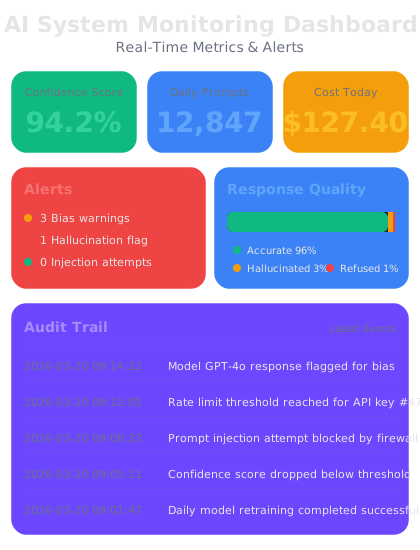
Auditing for Quality — Hallucinations, Accuracy, Bias, Fairness, and Access
Monitoring tells you what is happening in real time. Auditing is the periodic, systematic evaluation of whether an AI system meets its quality, safety, and compliance requirements. Auditing is retrospective, thorough, and often conducted by parties independent of the AI operations team.
Hallucination auditing evaluates the frequency and severity of model confabulation — instances where the model generates plausible-sounding but factually incorrect information. Auditors compare model outputs against verified ground truth to measure hallucination rates. For high-stakes applications (legal, medical, financial), hallucination audits should be conducted on a regular schedule and triggered by any model update. Hallucination rates should be tracked as a key performance indicator, with defined thresholds that trigger remediation actions such as model rollback, additional fine-tuning, or the addition of retrieval-augmented generation.
Accuracy auditing measures overall model performance against labeled evaluation datasets. Accuracy metrics vary by task type: classification tasks use precision, recall, F1 score, and area under the ROC curve; generative tasks use metrics like BLEU, ROUGE, and human evaluation scores. Accuracy audits should include adversarial evaluation — testing the model with inputs specifically designed to cause errors — in addition to standard benchmark testing.
Bias and fairness auditing evaluates whether the model treats different demographic groups equitably. This includes testing for disparate impact (whether the model's outputs disproportionately affect particular groups), representation bias (whether certain groups are underrepresented in training data), and stereotyping (whether the model reinforces harmful stereotypes). Bias audits require carefully constructed test datasets that span relevant demographic dimensions. Regulatory frameworks such as the EU AI Act increasingly mandate bias auditing for high-risk AI systems.
Access auditing reviews who has access to the AI system, at what privilege level, and whether that access is appropriate. This includes access to the model itself (inference endpoints), training infrastructure, training data, model weights, configuration parameters, and monitoring dashboards. Access audits should verify that the principle of least privilege is enforced, that service accounts are not over-privileged, and that former employees and contractors have been deprovisioned.
Comprehensive AI auditing brings all these dimensions together into a regular cadence — quarterly or semi-annually for most organizations, more frequently for high-risk applications. Audit findings should be documented, tracked, and remediated with the same rigor as findings from traditional IT audits. The audit trail itself becomes a compliance artifact that demonstrates due diligence to regulators, customers, and stakeholders.